
Eleanor Roosevelt once said that people should learn from others’ mistakes because life is too short to make them all oneself. That’s a philosophy that we have endeavoured to both implement and share through our work at Apulia Grove. We benefited enormously from the bountiful knowledge of other small growers when we entered the olive industry in 2007. Now we also work to pay it forward through our on-going business development.
The Grove
This week, I have been working with another local grower a short drive up the road at Colbinabbin. Fifteen years ago, this couple planted a tiny grove of just 70 trees; Manzanillo and Kalamata varieties. With a little TLC, we’re hoping to finally get some fruit next harvest. The particular challenges of this grove include scale and ant infestation, and sooty mould on a large proportion of the trees.
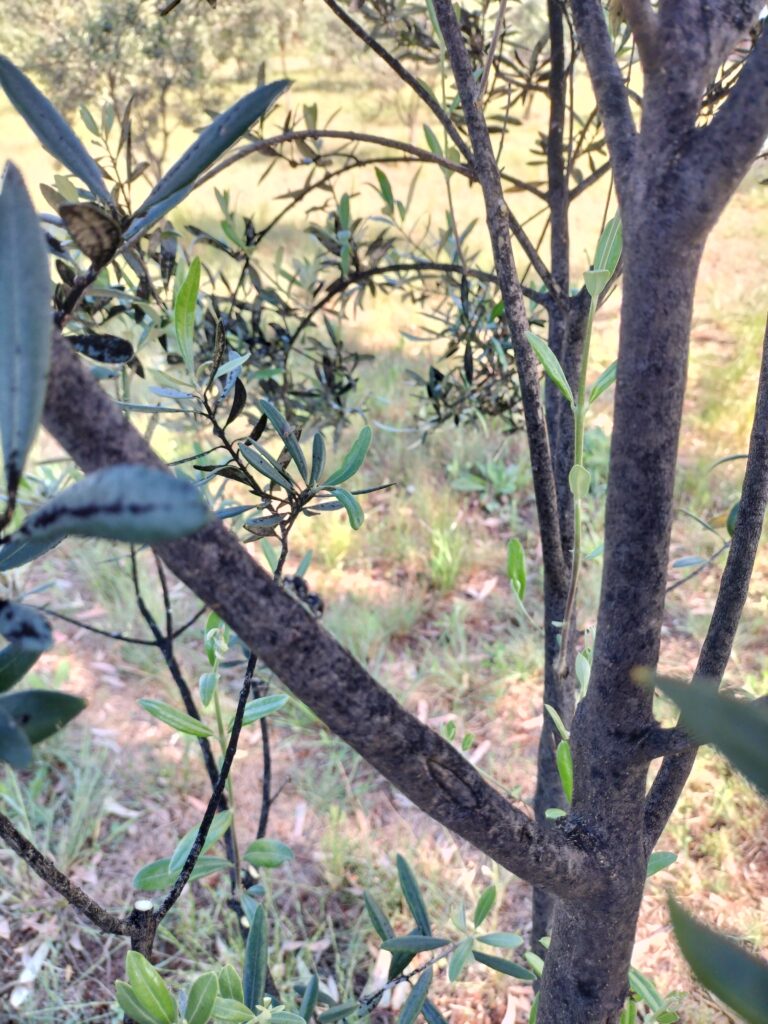
Sooty mould (the blackness on the leaves and trunk) was a major problem in large parts of the grove.
The Work
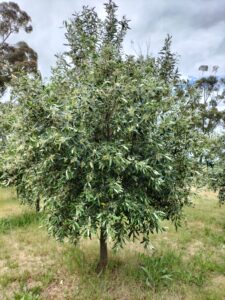
One of the 15 year old trees before pruning began. Note the height in the top centre of the tree.
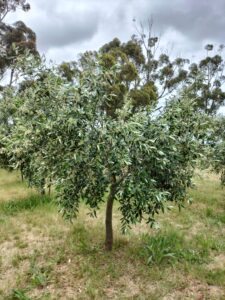
The last stage of pruning is lifting the “skirt” of low hanging branches around the tree, and thinning the ends of the tertiary branches so that any fungicide or insecticide sprays can effectively penetrate the canopy. All sprays recommended by us are targeted for specific use (not broad spectrum) and allowed under organic certification (where possible).
My approach is to prune the canopies to allow air and light to penetrate. After that, I’ll apply copper hydroxide as a fungicidal spray. This spray will help to mitigate the risk of anthracnose also developing on the fruit due to seasonal humidity. It’s now too late in the season to spray a targeted insecticide against the scale. However, we’ll keep an eye on the trees and if another generation appears to be developing, we’ll deal with that in due course. Sticky bait tape will also be applied to the tree trunks to help deter the ants. This remedy will have a flow-on effect to help stop the spread of the sooty mould spores by restricting ant movement.

Pruning trees at this level of unruliness involves removing around 30% of the canopy in one go, starting with the largest branches and opening the centre of the tree. The first cut removed the excess height.

The second cut removed another large branch from the centre of the “vase”, returning the tree to a main frame of trunk (primary branch) with three or four secondary structural branches on which the fruit-bearing wood (tertiary branches) will be held.
I’ll be making sure to apply a decent feed of compost around each tree to help maintain soil moisture. Ants are less active in cool and damp conditions, so mulching the trees helps to deter them in the immediate vicinity.
The Outcome
The varieties in this grove are looking good for table olive production. Many people feel table olives are too labour intensive, so not as many growers produce them. However, naturally fermented table olives are both a revelation in flavour (compared to industrially pickled olives) and a lot easier to produce than suspected. The main thing to keep in mind is that if they smell bad, don’t eat them! Some fermentation bacteria can be lethal if ingested. As any business owners would know, customers can be hard enough to come by without killing the ones with whom we have already connected.

The first pile of pruned branches, which were chipped into a pile about the volume of four basketballs.

The rest of the pruned branches, still awaiting chipping.
I’ve thoroughly enjoyed getting out to visit another grove, and being able to provide some support and care to the trees so that they can also live up to their potential. Pruning in the rain is not my favourite pastime but, as the Scandinavian proverb goes: “There’s no such thing as bad weather, only inappropriate clothing.” It will be nice to see some sunshine as the season progresses, but watch out for the development of additional fungal diseases which can increase the incidence of biennial bearing in olive trees.



Leave A Comment